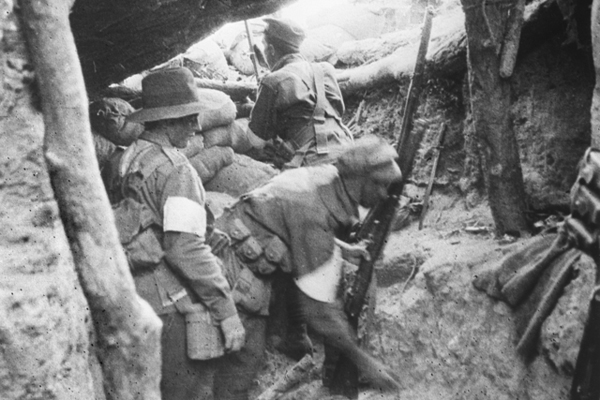
August 2015 marks the Centenary anniversary of two famous moments in Gallipoli history. While the charge at The Nek has been captured in the Peter Weir film Gallipoli, less has been said about the famous battle of Lone Pine. Several Bacchus Marsh District soldiers were involved in the Battle of Lone Pine, including Corporal Bill Morton, Private Maurice Whelan and Corporal William Henry Platt.
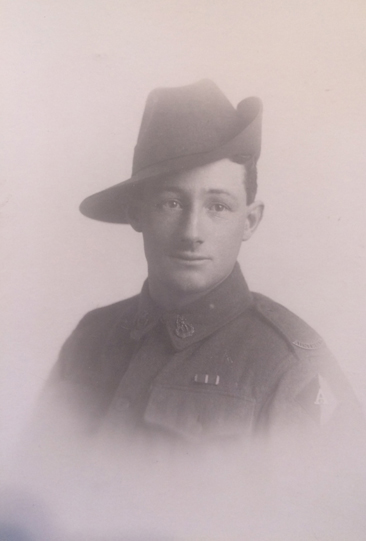
Corporal Platt enlisted on January 11, 1915 as part of the 5th reinforcements of the 7th Battalion. A 25 year old labourer, he joined the 7th Battalion at Gallipoli on the 17th June 1915 and was part of the initial battle at Lone Pine.
His letter dated October 13, 1915 appeared in the Bacchus Marsh Express and gave great detail about what happened : “On 6th August we were told to be ready to charge at 4.30. You would think we were going to a picnic, we were all so excited. But as the time drew near, every man knew that he was going to face certain death, but soldiers count their lives as nothing. Fear goes when facing a task.
“All you think of is, we shall win, and must do our share, we can’t expect to without, and right is might. Well, right on the tick of 4.30, the guns of the ship started, and then our batteries and howitzers. The Turks started to pour bombs into our lines for all they were worth. The shells were screeching and bursting all round, rifles cracking, and the rumble of the distant guns. All together it put you in mind of a terrific thunder storm. I hate to think of it now.
“Then at 5 o’clock suddenly the noise ceased. We know something was going to happen. The order was given to the 4th Batt. to “charge”. Then the awful din commenced. Our Batt. (7th) was in the support trenches at the time, waiting their turn. The steady fire was kept up right along the line. We just laid in our trenches, waiting our orders. We lost a good many men from the shells, but our turn came.
“My word, you don’t know
what anxiety is until you think you
are losing, and dying for nothing”
“We were sent down to the Lone Pine to relieve the 4th Batt., who by this time had taken a trench. It was a terrible corner. I have seen sights I shall never forget. There were hundreds of Turks and our boys lying together, and every spare trench and corner was packed with dead bodies.
“The Turks’ next trench was, only ten yards away and I can tell you they were pouring the bombs over on us. We were replying, but our men were falling fast, and I expected my turn any minute. I got knocked out three times that night. First with a piece of steel on the back of the head, which is numb yet, and cuts all over the face. I got them dressed (our brave Red Cross workers are with us all the time), and rushed back to my post. I didn’t think we would be able to see that relief through. My word, you don’t know what anxiety is until you think you are losing, and dying for nothing.
“I had a few narrow escapes. A bomb dropped at my feet, but did not go off. Another near me killed my old camp mate, and another rolled into the trench and killed three of our men. Some of the poor fellows who were badly wounded crawled out of the trench, and were hurried back into safety. I had to keep my fire on the communication trench all the time, to keep the Turks from getting round and throwing bombs up the trench. One black brute got through and fired at me but missed. I kept my fire up, but do not know whether I hit him or otherwise, as it was dark.
“Our boys were falling fast, and I did not know how long I would last, as the Turks were gaining on us. I was beginning to feel a bit faint, as by this time my legs and arm had not a few shrapnel cuts, but I dare not leave my post. At last I got hit on the jaw and dropped. That put me out of action. I did not know where I was, or what I was doing, and did not seem to care. I hobbled down the trench toward the beach (someone else took my post) when a bullet caught me in the side, and I dropped.
“I remembered no more until I was on a hospital ship, bound for Alexandria, where we stayed four days. We may do a little in this struggle, but, by jove, where would we be but for our brave Red Cross boys, and the still braver nurses. They win the battles.”
Corporal Platt was discharged on January 26 1916 as medically unfit.
Morton and Whelan
Morton and Whelan were amongst the first to enlist on August 19, 1914. Both farmers, Bill was a 20 year old from Myrniong and Maurice, 30, from Parwan.
They embarked together on the October 19, 1914 aboard the HMAT Wiltshire as part of the 4th Light Horse Regiment. The 4th Light Horse arrived at Gallipoli in May 1915 and were used to strengthen existing battalions before being reunited in June.

In a letter, Morton wrote: “For the last month we just drop down and go to sleep where ever we happen to be, when let off duty. We don’t even bother about a water proof sheet or blanket. It is not unlike sleeping in the middle of a paddock, only there is plenty of stray lead knocking about. I’m beginning to feel pretty knocked up.”
Morton and Whelan were both members of C Squadron of the 4th Light Horse and on August 21 1915 were sent to relieve the 7th Light Horse at Lone Pine. The unit diaries reveal heavy shelling and machine gun fire on the 22nd by the Turkish soldiers, and “parapets had to be built up under very heavy shelling”.
That day Private Whelan was badly wounded badly in the left leg with gunshot wounds and was sent to England to recover in hospital. The injury was so severe that in August of 1916, Maurice returned to the Marsh and a report in the Bacchus Marsh Express noted “He is able to walk with a stick”.
Corporal Morton was injured with gunshot wounds to the face the same day and also sent to hospital in England. A letter written later by Sergeant Harry Campbell on January 5, 1916 stated: “Also saw Willie Morton, he has just returned from England. He had a wonderful escape he and another chap were sitting back to back, when a shell hit them. The other chap was blown to bits, and Morton’s face was badly cut about but that was all; the doctors made a wonderful job of him, because you can scarcely see any mark left.”
Corporal Morton returned to his regiment and was injured again in September 1918 with a bomb wound to the chest and left thigh. He had been awarded the Meritorious Service Medal in June of 1918. Morton was fully discharged in June 1919.
All three soldiers have commemorative trees on the Bacchus Marsh Avenue of Honour.
By Katrina Bradfield
Great War Centenary Committee, Bacchus Marsh has provided this seventh article in a series 2014-18 to mark the centenaries of World War One, assisted by Melton & Moorabool StarWeekly (originally The Bacchus Marsh Express)