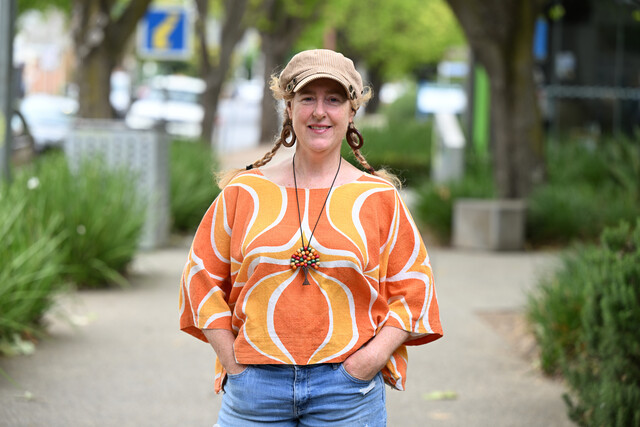
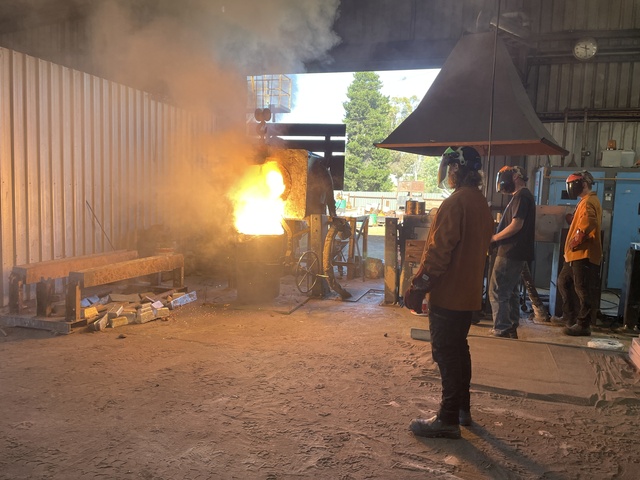
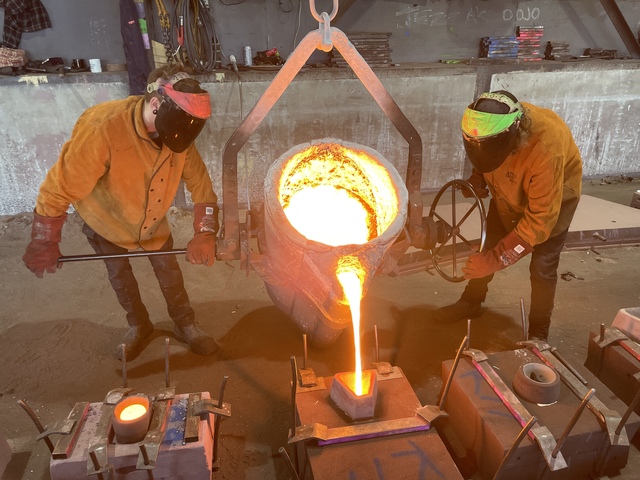
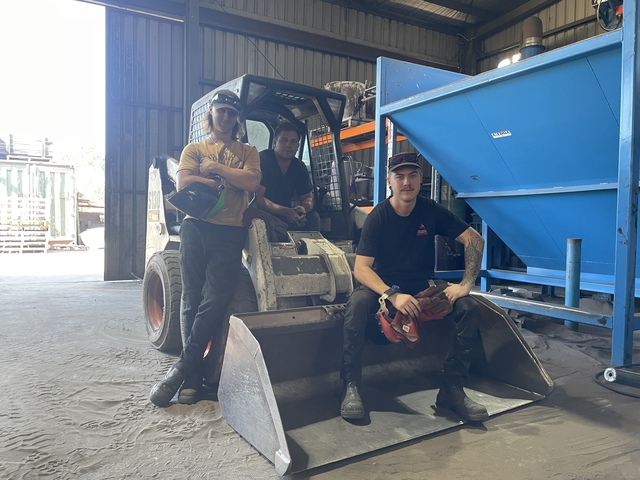
In an era dominated by screens, automation and rapid turnover, the clang of tools and the glow of molten metal feel like relics of another time – but not in what’s now a rare sight of a foundry tucked away in Castlemaine. At just 22 years old, Trentham local Declan Whitehouse is helping ensure it doesn’t fade away.
While many young Australians are encouraged toward university pathways and digital careers, Declan Whitehouse has taken a different road, committing himself to the centuries-old trade of metal casting at Billman’s Foundry, a job which demands physical endurance, patience, and a respect for materials – and one which fewer young Aussies are choosing to learn.
Yet for Declan, 22, the foundry floor feels like home.
“I’ve always liked working with my hands,” he says simply.
“There’s something honest about it. You can see what you’ve made at the end of the day.”
Billman’s Foundry serves as one of Australia’s leading manufacturers in cast iron, brass, aluminium and steel products, using techniques that have changed little over the generations.
The work is hot, heavy and unforgiving, but it carries a sense of permanence that Declan believes is missing from much of modern working life.
“It’s not a job where you sit back,” he says.
“You earn everything you make.”
That attitude didn’t appear overnight. Declan grew up in Trentham surrounded by a culture of hard work, where effort was valued as much as outcome. From a young age, he was taught the importance of showing up, listening, and learning from those who’d been there before him.
Those lessons carried weight when he stepped into the foundry as a young man, one of the youngest workers on the floor.
“At first, you don’t know much at all,” Declan admits.
“You’re watching blokes who’ve been doing this longer than you’ve been alive.”
Rather than feeling intimidated, he leaned into it.
“You learn by watching, by asking questions, and sometimes by making mistakes,” he says.
“But you have to respect the people who came before you. They’ve kept this place going.”
Much like Australia’s former manufacturing hubs, the foundry is built on generations of accumulated knowledge; things that can’t be learned from manuals alone. Every mould, every pour, every element that makes the metal relies on instinct sharpened through years of repetition, and it’s that passing down of skills that Declan sees as vital.
“There aren’t many young fellas coming into this kind of work,” he says.
“If no one learns it, it just disappears.”
His supervisors agree. Older tradespeople at Billman’s have watched apprenticeships thin out, with fewer young workers willing to take on physically demanding roles. For them, seeing someone like Declan commit to the craft offers a rare sense of reassurance.
“They look out for you,” Declan says.
“But they expect you to work hard, too. Nothing’s handed to you.”
The days start early. In the winter, the harsh snap of the metal in the early morning makes using the fingers an almost impossible feat, and gloves become your best friend.
The work is far from glamorous, it’s sweaty, noisy and often relative, but Declan says the sense of pride outweighs the hardship.
“You end the day exhausted, covered in the sand, dust and grime, but you know you’ve done something real,” he says.
That sense of real, hand-made work is something those on the floor feel is becoming undervalued, particularly among younger generations pressured in chasing speed and convenience.
“There’s nothing wrong with office jobs,” he explains.
“But trades built this country. We shouldn’t forget that.”
And it’s true – Australia’s industrial history is one defined by factories, foundries and workshops and has become steadily eroded over recent decades.
As more and more manufacturing plants closed and production moved offshore, entire skill sets were lost with them.
Declan is acutely aware of the rich history, even if he didn’t live through its peak.
“You hear stories from the older boys here – how busy it used to be. Groups of people, all working together,” he says.
“It’s different now, but in a way it makes the camaraderie that much tighter.”
At Billman’s the work continues much as it always has. Sand moulds are crafted by hand, and the melted metal is poured with precision and care – mistakes aren’t easily undone.
“Everyone has to be pretty switched on,” Declan says.
“One wrong move can ruin hours, even days of work.”
The pressure has made him mature quickly. At 22, he carries himself with the quiet confidence of someone comfortable with the responsibility of handling a 600kg ladle of molten metal.
Outside of work, he remains grounded in his Trentham roots, valuing community and routine over flash ambition, only choosing to speak about doing better at what he does.
“I just want to keep learning,” he explains.
“There’s always more to know, and a lot of experience to be shared on that floor.”
On the floor, success isn’t measured by speed or status, or even experience, but by mastery and learning–- something the foundry gives in to teaching daily.
“Some days are tough,” he admits.
“But it’s something the older blokes here will always tell you; if it was easy, it wouldn’t be worth doing.”
It’s the same philosophy which mirrors the values that once underpinned Australia’s manufacturing identity in resilience, loyalty, and pride in workmanship. All values Declan himself believes still matter, even if they’re less visible now.
“People think the old trades are outdated,” he says.
“But they’re not, they just don’t get talked about as much.”
As industries evolve and technology reshapes the workforce, Declan sees a place for both progress and preservation.
“I think we can move forward without losing everything from the past,” he says.
“Someone still has to know how to make things – we wouldn’t be anywhere otherwise.”
Standing at the edge of a glowing furnace, bearing a worn sledgehammer on its fourth replaced handle of the year, Declan, along with his work colleagues, mates and fellow foundrymen, represent more than just a trade which used to stand at the pinpoint of Australia’s growing industrialism – they represent continuity and a bridge between generations who shaped metal with their hands and those willing to do the same in a world increasingly removed from physical creation.
While the trade of metal casting may be fading elsewhere, on the foundry floor in Castlemaine under the Billman name, and in the hands of a 22-year-old from Trentham, it’s still very much alive.