
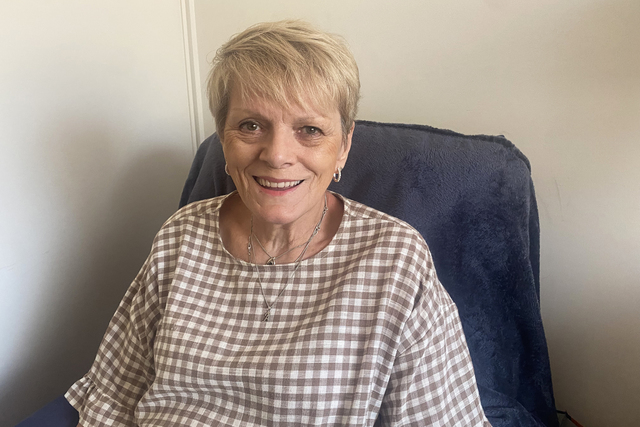
Little is known about a form of dementia that affects more than 100,000 Australians but researchers are looking to build knowledge on the debilitating illness as Melissa Meehan explains.
Two years ago, Annette was running a thriving small business and planning her next solo holiday.
Today she’s mostly confined to her aged care facility, unable to go out unchaperoned.
She can no longer trust her legs to keep her upright, relying on a four-wheel walker or sometimes a wheelchair to move around. Her ability to swallow her favourite foods is gone, she cannot control her body temperature or blood pressure.
When she is tired, her body slumps and speech is slow and slurred.
Annette’s memory is pretty good for the most part. She recognises the faces of loved ones and can hold a conversation. But sometimes she talks to people who aren’t there.
She does her hair and puts on make-up every day, but cannot always remember why she’s sick and the reason for her new limitations.
Such is the rollercoaster of a Lewy body dementia diagnosis for Annette, one of 100,000 Australians living with the condition that affects memory, thinking and bodily functions.
For members of Annette’s family, a rollercoaster is the only way to describe it.
Some days she seems really well, like she was before she got sick. Other days she experiences hallucinations, cognitive decline, a range of movement issues and other symptoms that make the condition so challenging.
But those good times can change in a moment, and Annette can go from walking and talking to a frail, confused version of herself.
“It (the diagnosis) has been difficult to get my head around, because most days I feel good and I don’t remember the bad days.“ she said.
“So with that in mind, I get really frustrated with the limitations I’m now living with – like not being able to go out on my own, I really value my independence and that feels like it’s been taken away from me.
“But I also understand that I am not well, and it’s a constantly changing beast. It’s a horrible diagnosis and I’m just trying to live my life the best I can, while I can.“
To everyone that knows her, it’s understandable that Annette sometimes feels like a prisoner.
In 2023 she took herself on solo trip to Tasmania and Queensland after closing her local business a year earlier. She played pickleball weekly, cared for her grandchildren and was always out and about.
But over the course of 2024 she suffered as many as eight strokes, more than 20 mini-strokes and spent much of the year in hospital. In November she was diagnosed with Lewy body dementia and the symptoms came on thick and fast.
Lying in a hospital bed after another stroke, Annette lost strength in her left side, was unable to move her left leg and spoke to people who weren’t there.
She could not stay awake long enough to finish a sentence and whatever she said was slow, slurred and nonsensical.
Months later, her neurologist marvelled at her recovery and said he did not expect her to leave the hospital alive.
Lewy bodies are a protein that attack and then eat away at the brain, affecting memory, thinking, behaviour and bodily functions.
The prognosis isn’t great for those who are diagnosed. Life expectancy is around seven years and many die before the disease takes hold from infection, falls or other illness.
It is not as well known as Alzheimer’s disease but more than 100,000 Australians live with it, according to Dementia Australia.
And while not the same as Parkinson’s disease it shares a number of symptoms including hand tremors, slowness, stiffness and walking problems.
There is no cure and Annette has been prescribed dementia and Parkinson’s drugs to slow her decline and relieve some symptoms.
Florey Institute fellow Pratishtha Chatterjee is among Australian neurobiology researchers who attended a recent international conference on Lewy body dementia held in Amsterdam.
She is working on blood biomarkers to enable timely diagnosis, prognosis and long-term study of the disease, and says such co-operation and sharing of knowledge matters.
“It underscored the importance of a multidisciplinary approach in advancing LBD research and care, highlighting the need for continued collaboration among clinicians, researchers and stakeholders,“ Dr Chatterjee said.
More funding is needed for research into Lewy body dementia, Parkinson’s Australia CEO Olivia Nassaris said.
“Currently, there is no cure for LBD and Parkinson’s Australia strongly supports investment in research to help us improve our understanding of the condition, to improve treatment and care for people living with LBD and their families and hopefully to find a cure,“ she told AAP.
*Journalist Melissa Meehan is Annette’s daughter.
Dementia | Explainer
Range of symptoms signal onset of Lewy body dementia
Lewy body dementia is relatively unknown despite more than 100,000 Australians living with the diagnosis that affects both the brain and body.
Lewy body dementia is a disease associated with abnormal protein that eats away at the brain and causes issues with thinking, movement, behaviour and mood.
There is no cure and little is known about the disease, with no definitive way of making a medical diagnosis until an autopsy is performed, leaving doctors to diagnose sufferers based on medical history, a physical exam and symptoms.
WHAT IS LEWY BODY DEMENTIA?
* “Lewy body dementias“ is an umbrella term describing two forms of dementia: dementia with Lewy bodies and Parkinson’s disease dementia
* Lewy body dementias cause changes in thinking, movement, behaviour and bodily functions
* There is no known cure for the Lewy body dementias yet, but the conditions are manageable and some symptoms can be treated.
WHAT CAUSES LEWY BODY DEMENTIA?
* Anyone can develop Lewy body dementia, but it becomes more common as people get older
* More than 100,000 Australians have Lewy body dementia
* Right now, it’s not known why Lewy bodies form
SIGNS AND SYMPTOMS OF LEWY BODY DEMENTIA
* Changes in thinking, behaviour, movement and bodily functions are symptoms of both types of Lewy body dementia
* Symptoms depend on which brain area is affected and the stage of the dementia. They can change over time
* Many of the changes can come and go, which are called fluctuations. There can be changes to abilities that last a few hours or a few days
* It can also change the way an individual thinks, concentrates and their behaviour
* Some also suffer from hallucinations that can feel very real for the person at the time – it can include loved ones, spiders or snakes
Source: Dementia Australia