
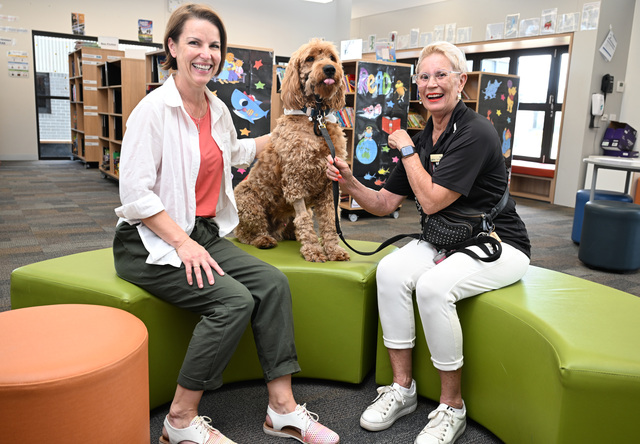
Meet Bunji, the wellbeing superstar who’s turning heads at Melton Specialist School and showing the important role therapy dogs can play in school communities.
Bunji the poodle has been a part Melton Specialist school’s community for almost four years, working to play a meaningful and supportive role for staff and students alike.
But Bunji’s journey started long before his arrival to the school, as disability inclusion and allied health leader Monika Engler explained.
“I worked closely with the founder of Dogs Connect, Grant, for several months prior to Bunji’s birth,” Mrs Engler said.
“He was thoughtfully selected from the very beginning for his role as a wellbeing dog.”
Dogs Connect is an evidence-based program which supports communities in introducing wellbeing dogs into environments like community care, aged care, hospitals, justice settings, emergency services, and schools.
The program aims to create a mutual and meaningful connection between dogs and humans in settings like Melton’s Specialist School, according to Dogs Connect founder Grant Shannon.
Ms Engler said Bunji’s introduction to the school was “gradual and intentional”, in a bid to ensure both Bunji and those around him felt safe, confident, and connected as a whole community.
“Bunji plays a meaningful role in supporting the wellbeing of both students and staff. He welcomes members of our community each day and provides quiet, steady support during more challenging moments,” she said.
“For many students, comfort comes simply from being near him – watching him, sitting alongside him, or gently connecting with him.
“His presence helps to reduce anxiety and ease nervous energy in a natural and non-intrusive way.”
Having a school wellbeing dog can help with anxiety, attendance, and emotional regulation, according to Mr Shannon.
“When the connection is felt and interactions are experienced, we know that humans and dogs can experience a release in oxytocin in their brains, which is a feel-good chemical,” Mr Shannon said.
“We also know that anxiety and heart rate can decrease almost instantly for humans and dogs, and we know that co-regulation happens quite naturally in an educational setting.
“This can lead to students feeling like they would like to be at school, potentially more than if the dog was not there.”
Mrs Engler said by just interacting with Bunji, both students and staff can build on their own practical skills in emotional regulation and social awareness.
“One of the most powerful aspects of Bunji’s presence is the immediate feedback he provides.
“In this way, Bunji becomes a living model for self-regulation, helping students build practical skills in managing their emotions and behaviour in a supportive and engaging way.”