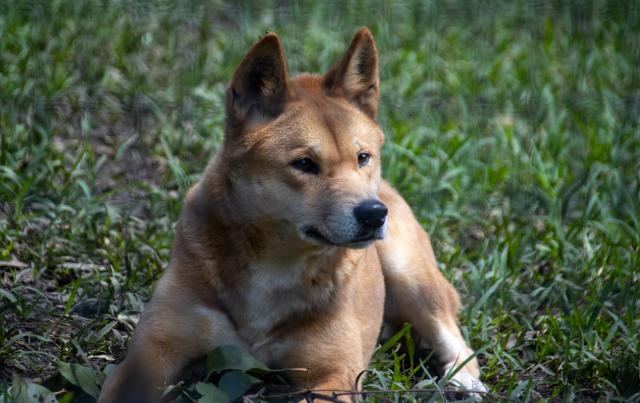
Genetic analysis shows dingo populations have significantly less dog ancestry than previously thought.
Wild dingo populations have less dog lineage, with a significantly greater proportion of pure dingoes than previously thought, according to new research, challenging the view that pure dingoes are on the decline due to crossbreeding.
The findings, published in Molecular Ecology, suggest previous studies significantly overestimated the prevalence of dingo-dog mixes in the wild and that lethal methods to control ‘wild dogs’ target pure dingoes.
Dingoes are genetically distinct from domestic dogs but can interbreed. Cross-species breeding, or hybridisation, can threaten pure species, which may become vulnerable to extinction by genetic dilution.
UNSW conservation biologist, and lead author of the study Dr Kyle Cairns said for decades, there was fear that dingoes were breeding themselves into extinction.
“But our findings suggest this isn’t the case, and dingoes are largely maintaining their identity, which has implications for their management and conservation,” he said.
For the study, the research team led by UNSW Sydney investigated the extent of dingo hybridisation in different regions across Australia. They used a new genome-wide test to analyse the DNA of 391 wild and captive dingoes and conducted detailed ancestry modelling and biogeographic analysis to find wild dingoes had far less dog ancestry than suggested by prior genetic studies.
Dr Cairns said the old method, which relied on a relatively small number of genetic markers and limited reference population, overestimates the amount of dog ancestry in dingo samples – sometimes by over 30 per cent.
“This meant it often identified an animal as crossbred when it was a pure dingo or historical backcross,” he said.
“But with the new test, we can look at 195,000 points across the genome compared with just 23 previously. So, it’s a huge step up in reliability and accuracy.”
In Victoria, where previous reports suggested the pure dingo population was as small as 4 per cent, the study found 87.1 per cent of animals tested were pure dingoes and 6.5 per cent were historical dingo backcrosses with more than 93 per cent dingo ancestry.
Similarly, in New South Wales and Queensland, where dingo-dog hybridisation is assumed to be pervasive, most animals were found to be pure dingoes, and only two wild canids had less than 70 per cent dingo ancestry.
Little evidence of hybridisation in the dingo population was also found in the Northern Territory, South Australia, and Western Australia.
Dr Cairns said reliance on outdated DNA testing methods has led to the belief that dingo–dog hybridisation is much more common in Australia than it really is.
“Most dingoes in the wild are pure dingoes, and the remaining animals are more dingo than anything else,” he said.
“Even in the parts of Australia where dingo-dog hybridisation is higher, it is not the pervasive threat we’ve been led to believe.”
No animals in the sample were 50 per cent hybrids – meaning none were direct offspring of a dog and a dingo in the wild. The few animals that weren’t pure dingoes were mostly historical backcrosses with a single dog ancestor four or five generations in the past.
Dr Cairns said while there has been some hybridisation in the past, it’s not occurring at a rapid pace today.
“Where it does happen, we can see the offspring of the hybrids returning to their dingo roots over time,” he said.
The study also found significant regional variation in dingoes, with four distinct wild dingo populations across mainland Australia.
Dr Cairns said they didn’t have samples from every single corner of Australia, so there may be even more variation in dingoes.
“There’s also a chance some dog DNA has been integrated into the dingo genome because it’s provided an evolutionary advantage, so that’s something we plan to investigate in future research using the new testing,” he said.
The findings are consistent with studies in other species demonstrating genome-wide analysis performs more accurate identification of ancestry, which policymakers can use to inform dingo management.
In Australia, the term “wild dog” is widely used in policy under the assumption there is widespread dingo–dog hybridisation and very few remaining pure dingoes.
Under the name “wild dog”, dingoes, dingo-hybrids, and feral domestic dogs are all considered invasive species under biosecurity legislation and subject to eradication measures like aerial baiting or trapping across parts of the Australian mainland, including National Parks where native animals are protected.
Dr Cairns said it’s convenient to paint all dingoes as wild dogs.
“But the term obscures the reality that many pure dingoes and dingo-dominant backcrosses are being killed,” he said.
“In fact, no other native species is treated in quite the same way as the dingo, which is subject to lethal control measures across all landscapes, including ones where they should be protected.”
Environments without dingoes can get overrun by kangaroos, foxes and feral cats that threaten other native animals and can change vegetation significantly.
Lethal control methods, particularly during dingo breeding season, may inadvertently increase the risk of hybridisation by reducing the availability of pure dingo mates. However, more research is needed to confirm the link.
Dr Cairns said while we don’t have many hybrids running around like previously suggested, where dingo-dog hybridisation does occur, it’s in regions where intensive lethal control is used and where there are higher numbers of domestic pet dogs.
The researchers suggest that the definition of “dingoes” in conservation policy should be revised to include historical dingo backcrosses with 93 per cent or more dingo ancestry and distinguish them from “feral domestic dogs.”
“Doing so will more accurately reflect the identity of wild canids in Australia and acknowledge the value of dingoes as a native and culturally significant species,” Dr Cairns said.